COSTA
It finds the beacon by how it blinks.
Coarse pointing, acquisition and tracking for a free-space optical link. It finds the partner terminal's beacon among stars, street lights and decoys by how it blinks, not how bright it is.
The problem
A free-space optical link is two terminals trying to hold a laser on each other. Before data can flow, the receiving terminal has to find the partner's beacon, centre it on a sensor, and keep it there while the mount moves and the air shimmers.
The hard part is not finding a bright spot. It is finding the right bright spot. The frame also contains stars, street lights, reflections and deliberate decoys. The partner terminal cannot make its beacon the brightest thing in the sky, but it can make it blink in a pattern.
The decision
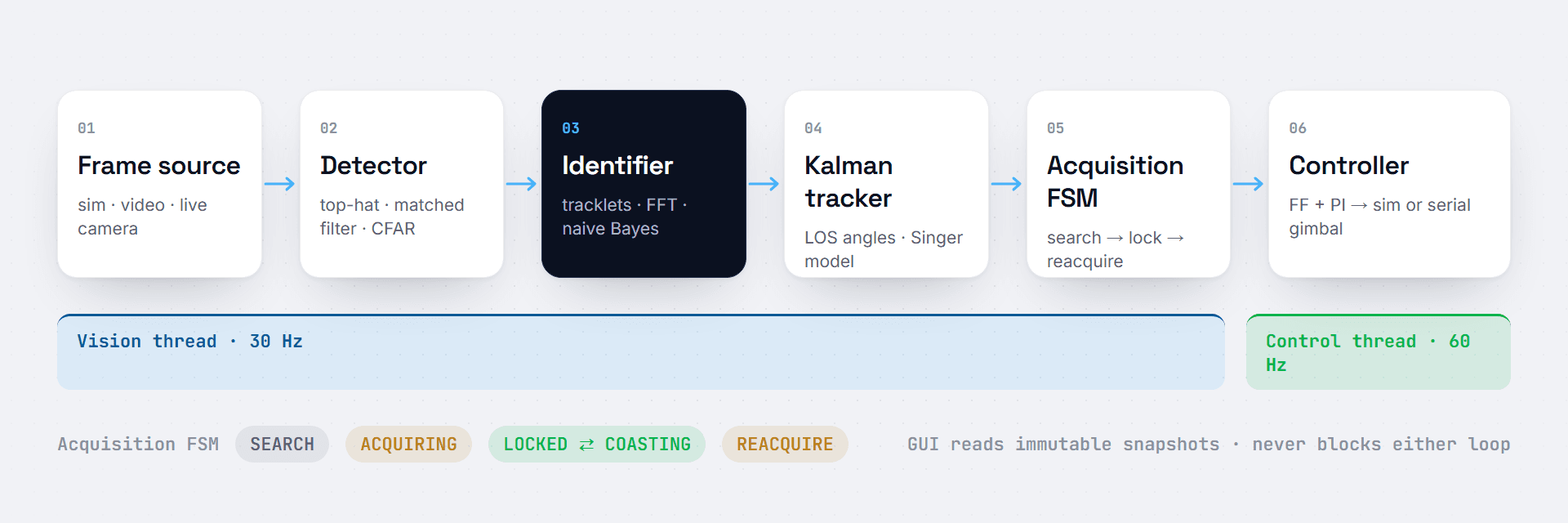
We identify the beacon by its blink signature. A window of frames is transformed into the frequency domain; the modulation frequency and duty cycle become a fingerprint that survives brightness changes, motion blur and background clutter.
Once the candidate is identified, geometry gives a coarse pointing estimate and a Kalman filter holds the track. The controller drives a pan/tilt gimbal at 60 Hz while vision runs at 30 Hz. There is no training dataset and no deep model in the loop.
Brightness is the one thing the partner does not control. Rhythm is. So we made rhythm the identity.
The build
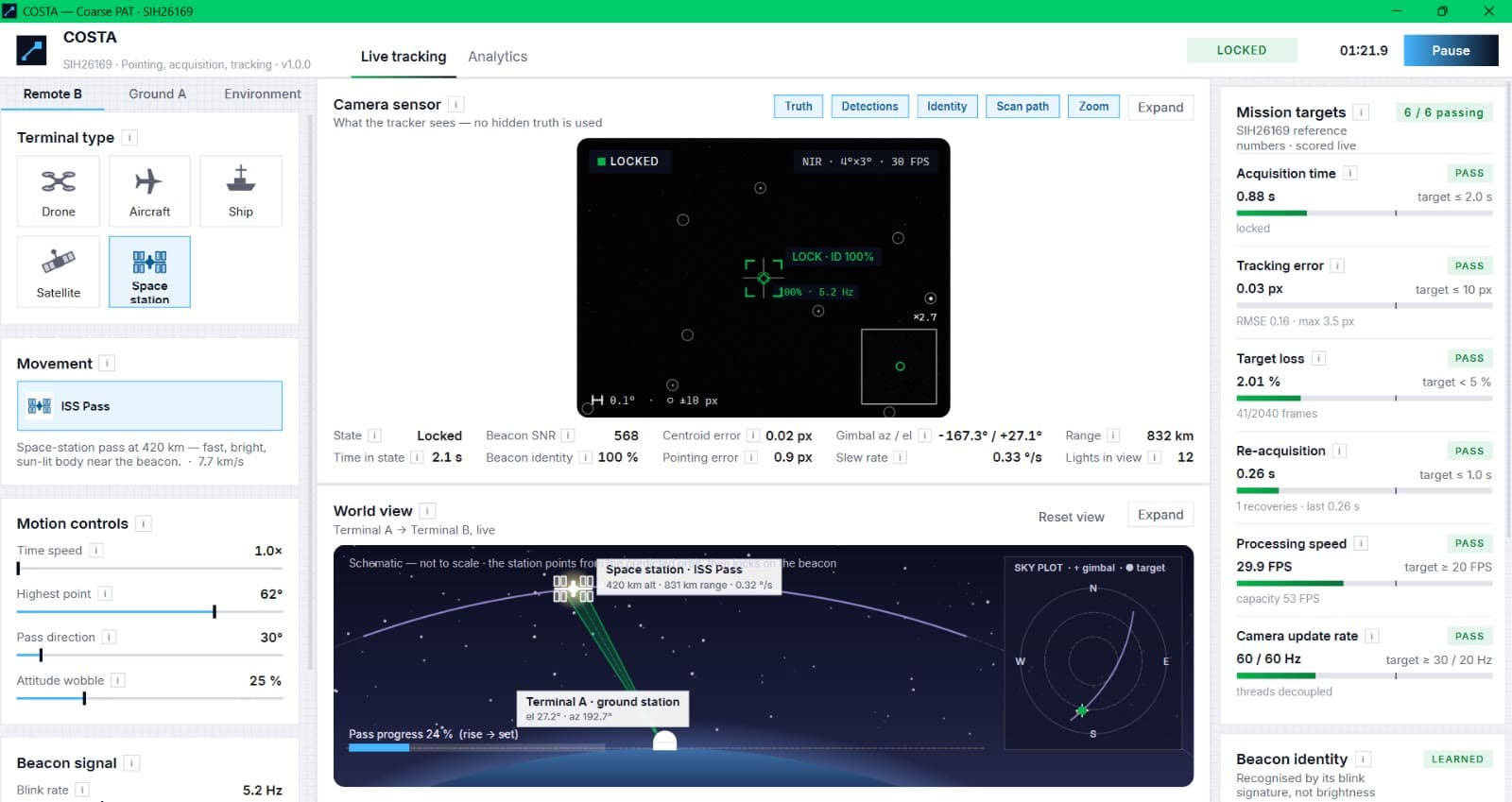
The application is a PySide6 desktop tool with a live camera view, a beacon-identity panel, an acquisition state machine and a tracking view. OpenCV handles capture and geometry; NumPy handles the Fourier analysis; the Kalman filter smooths the track between vision frames.
The system has a deliberate acquisition sequence: scan, detect candidates, score blink signatures, lock the best candidate, hand over to the tracker. Every state is visible in the interface, so an operator can see why the system chose a target.
- Blink-signature identification in the Fourier domain
- Geometry-based coarse pointing and a Kalman tracker
- 30 Hz vision, 60 Hz control, pan/tilt gimbal
- No training data and no deep-learning dependency
- Live acquisition and tracking interface in PySide6
The evidence
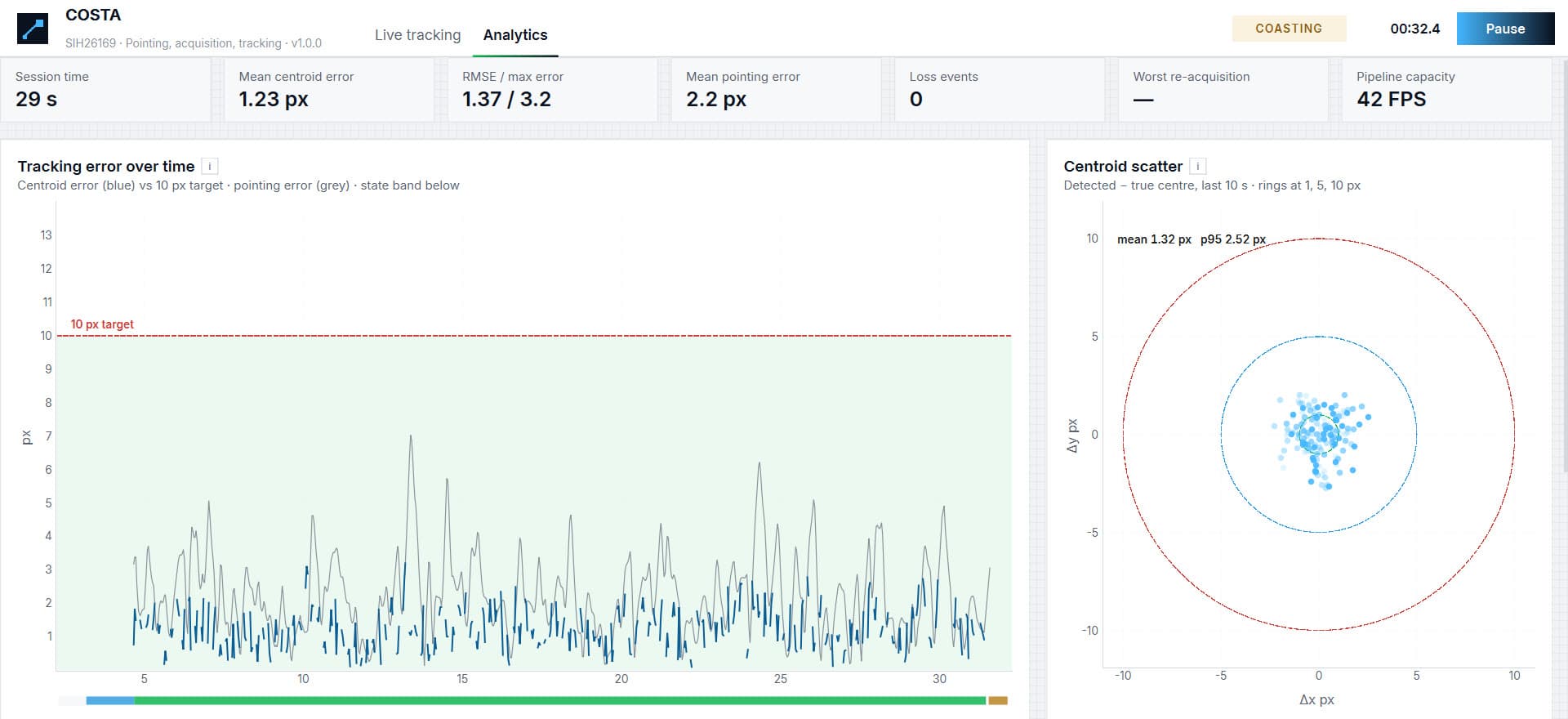
All 28 validation cases pass across six targets. Acquisition takes between 0.83 and 1.60 seconds, with a pointing error between 0.02 and 3.28 pixels. On real footage the system holds lock between 94% and 100% of the run.
The results matter because they come from the difficult cases: moving backgrounds, decoys, variable exposure and real camera noise. The system was built to be tested against those conditions, not a clean synthetic frame.
What I learned
I learned to look for the invariant that the other side controls. In a noisy environment, brightness, colour and position all drift. A deliberate modulation pattern is a signal the partner owns.
The second lesson was about interfaces. An operator will not trust an acquisition system that jumps to a lock without showing its reasoning. Making the candidate scores visible was as important as making the tracker accurate.